
One system, concept to mass production

The build, as of this morning.

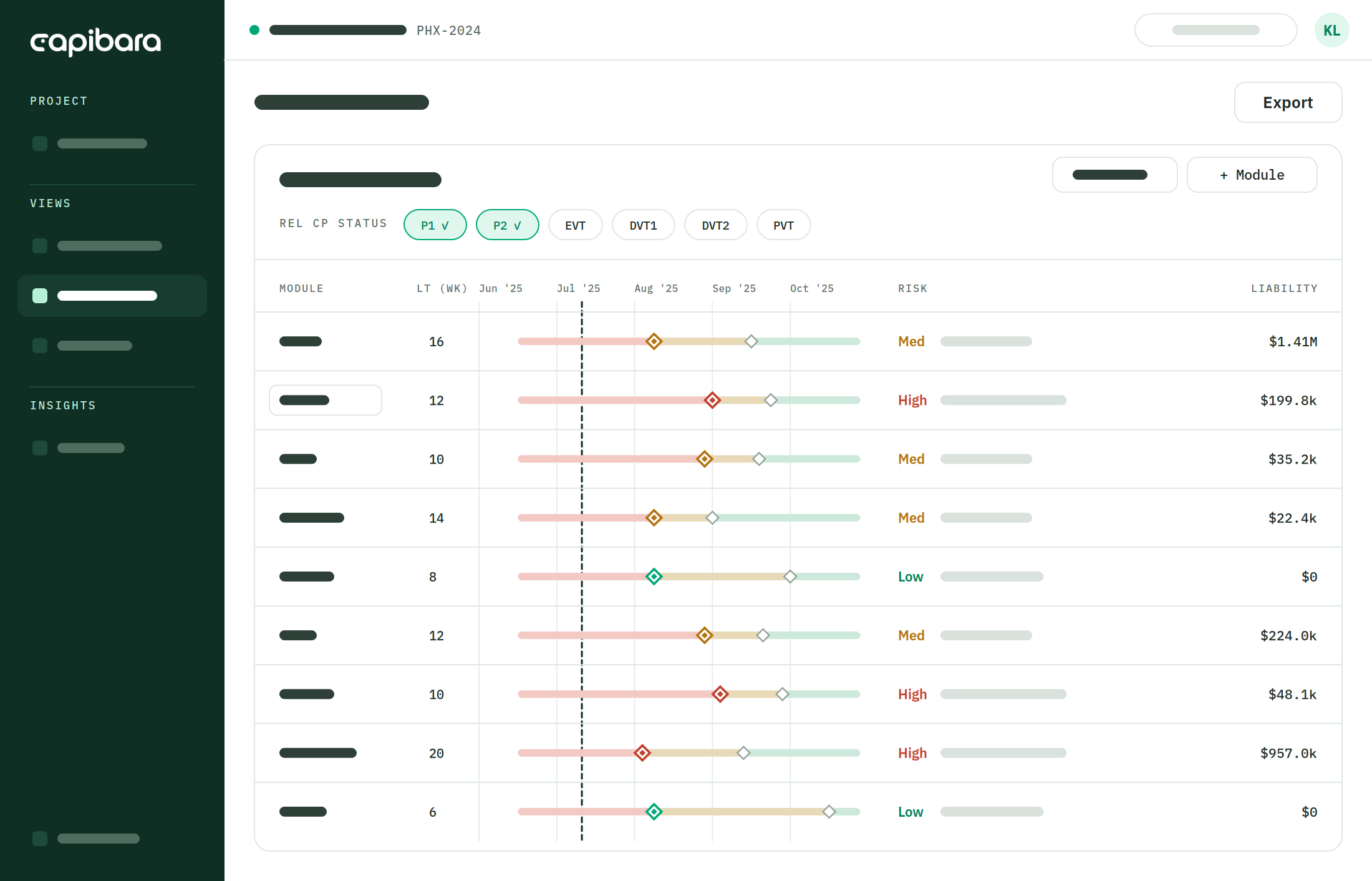
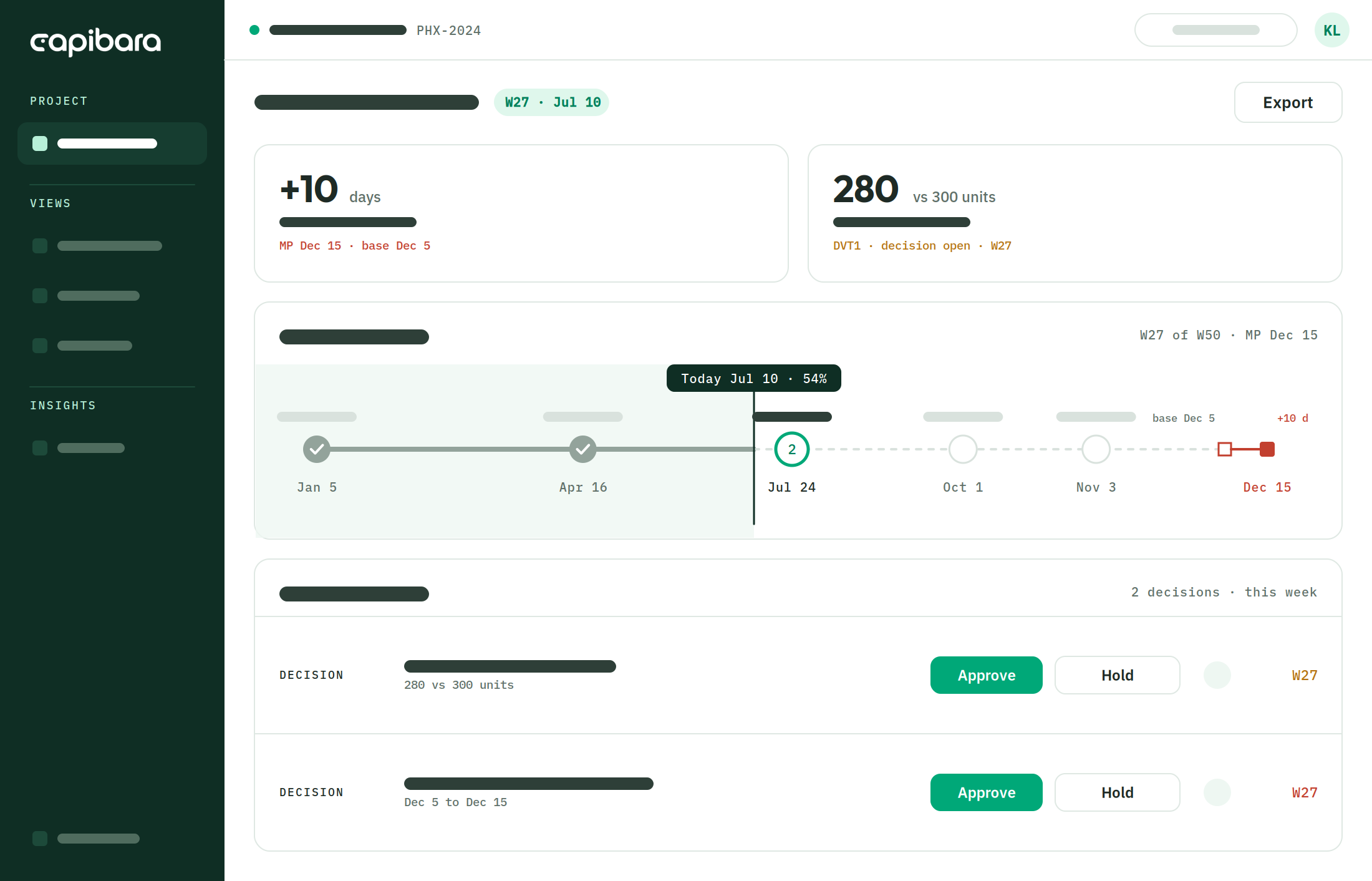
Units, yield, materials and the CM's numbers, entered once. What is on plan, what is slipping, and which fix still closes the gap, before anyone builds a deck.
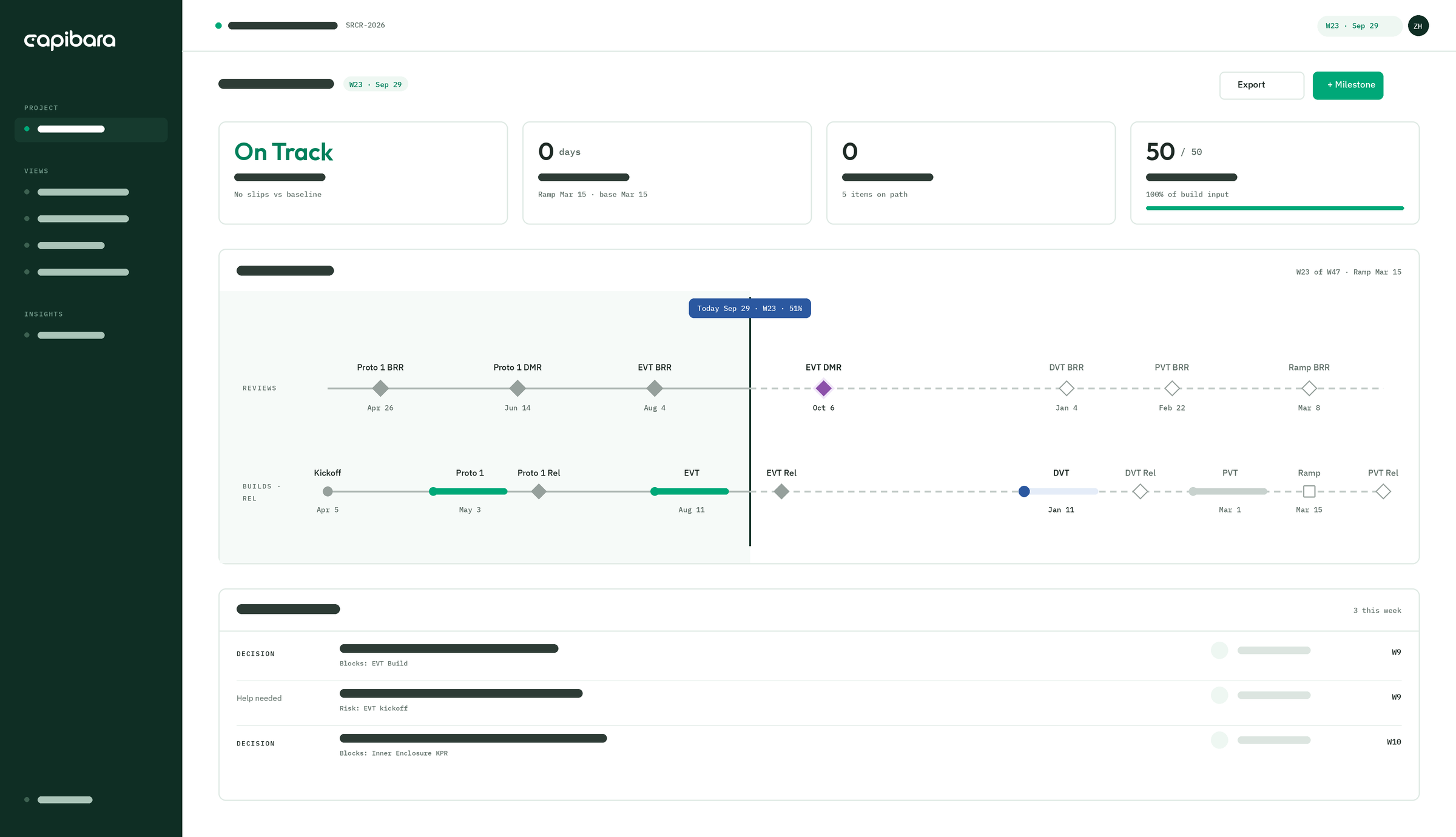
app.capibaraai.com/dashboard
capibara-mockup-dashboard-ontrack

Startup mode

Never launched before? Start here.

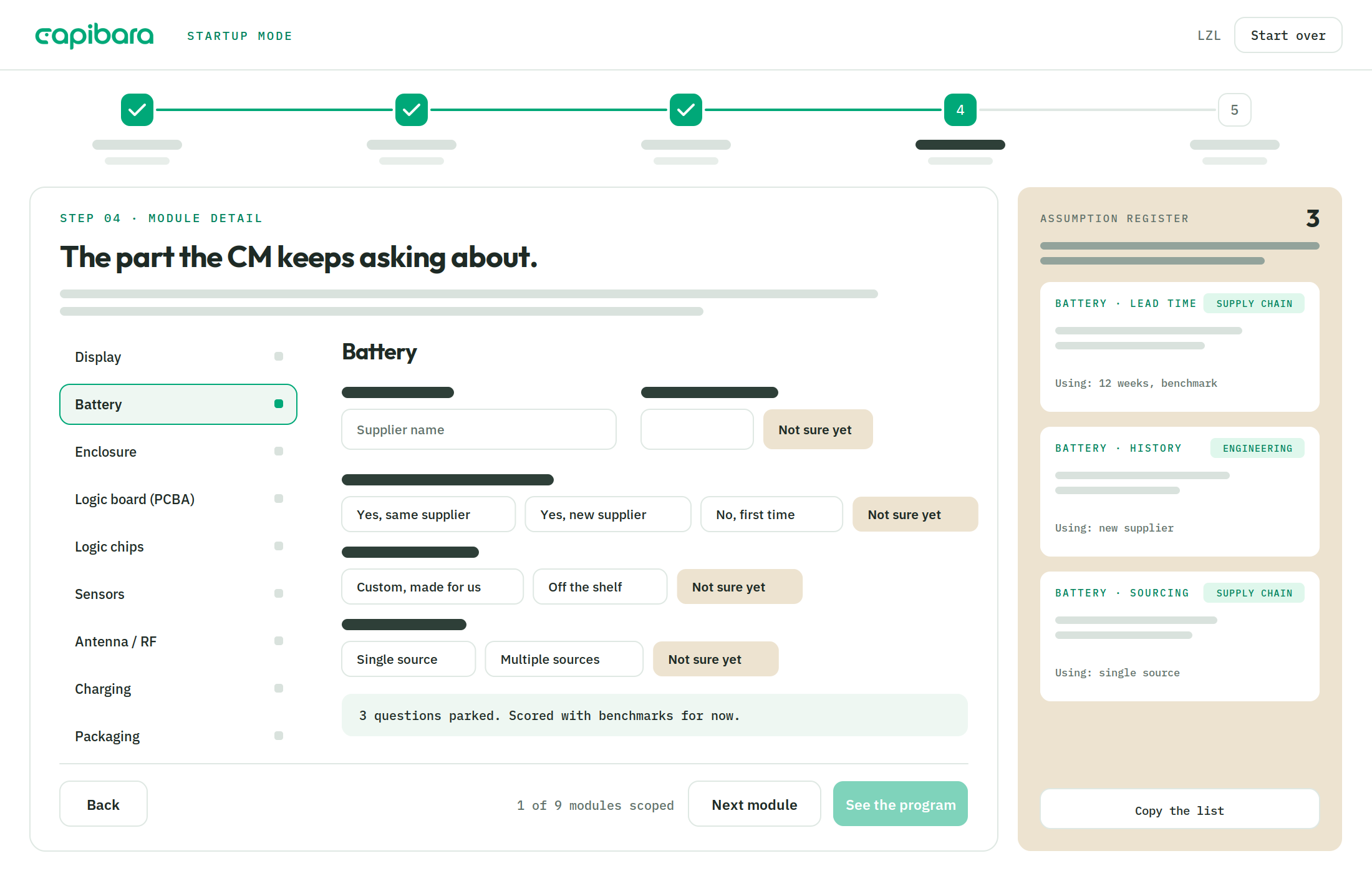
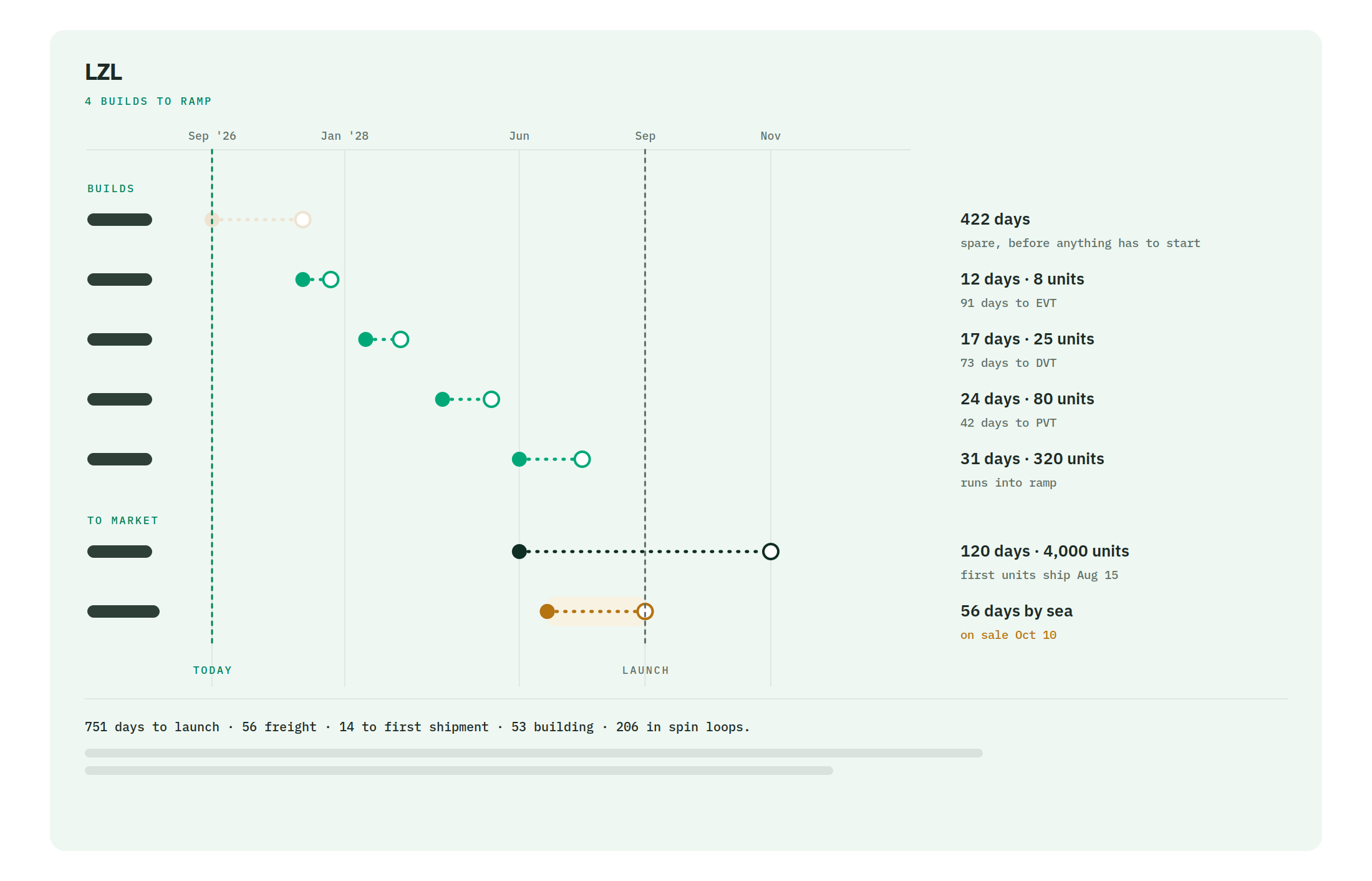
A launch date is not a plan. Small team, first launch, a date on the board and no program behind it. Start here. Four answers and Capibara drafts every build, its quantity and its spin loop, scheduled backwards from the day you ship, with every unknown on the record and assigned to whoever can answer it. No account, ten minutes, and it saves. When the build starts, we run it with you.
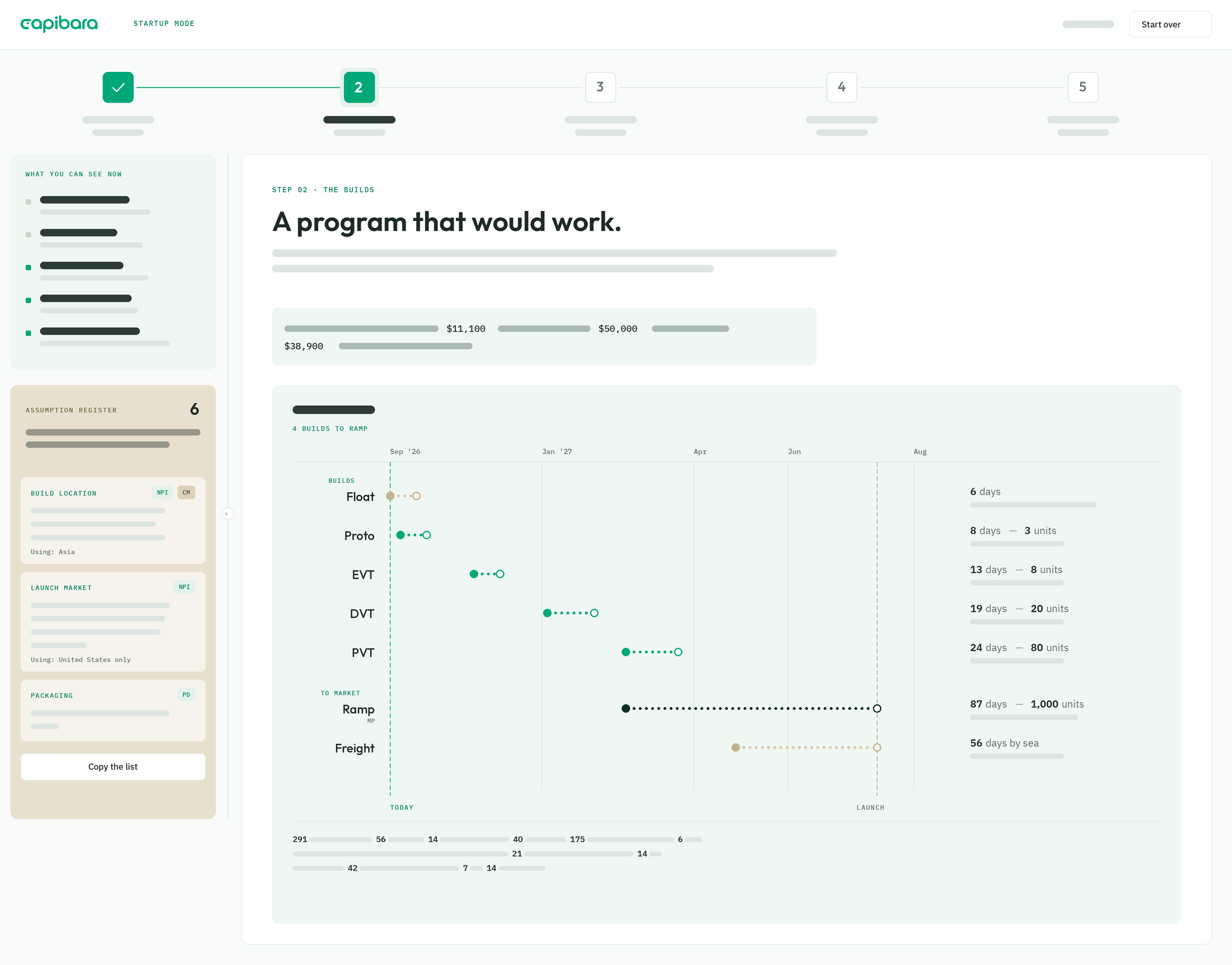
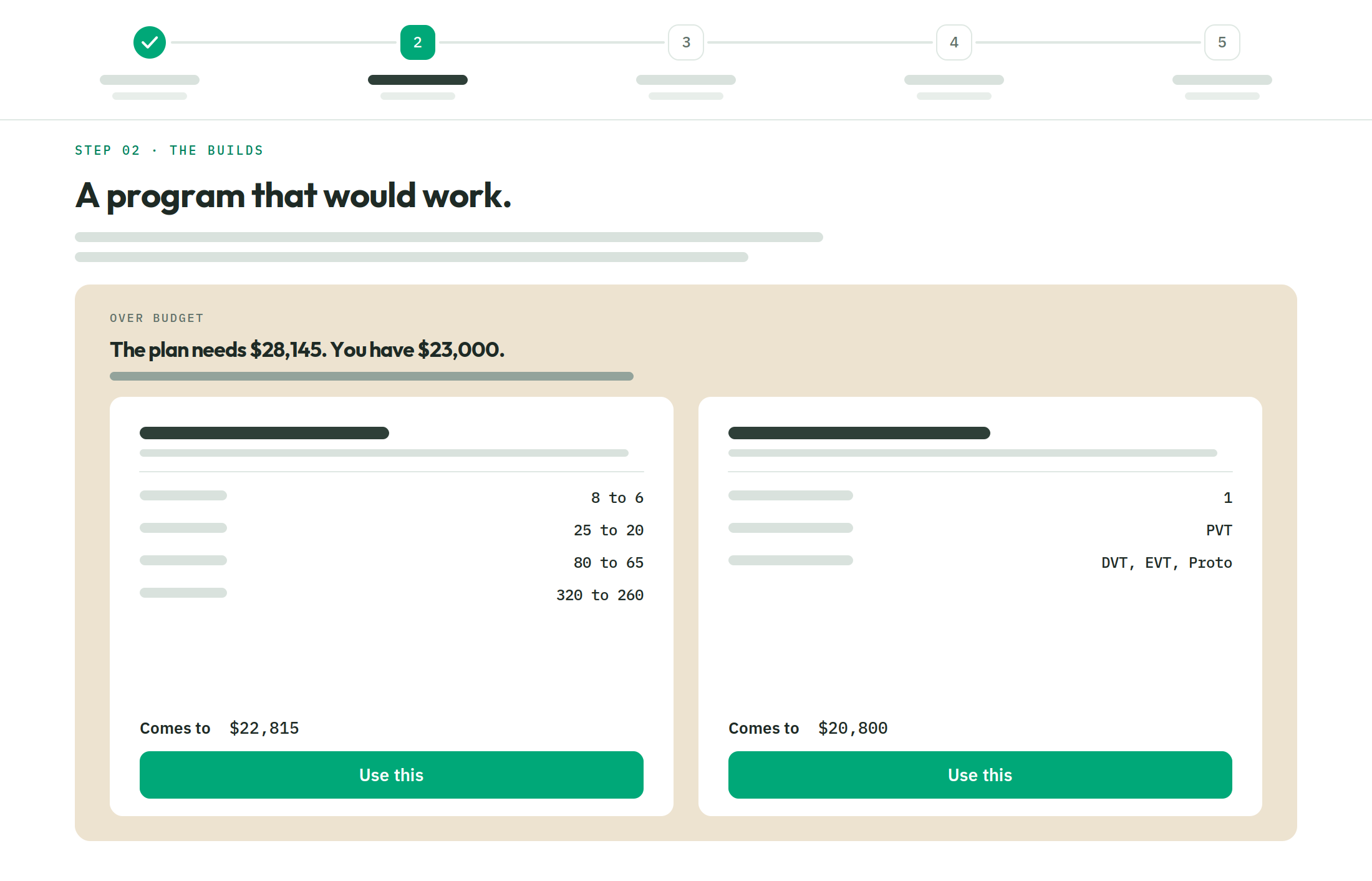
capibara-startup-step2-builds-2

The system of record

Enter it once. Everyone reads the same build.

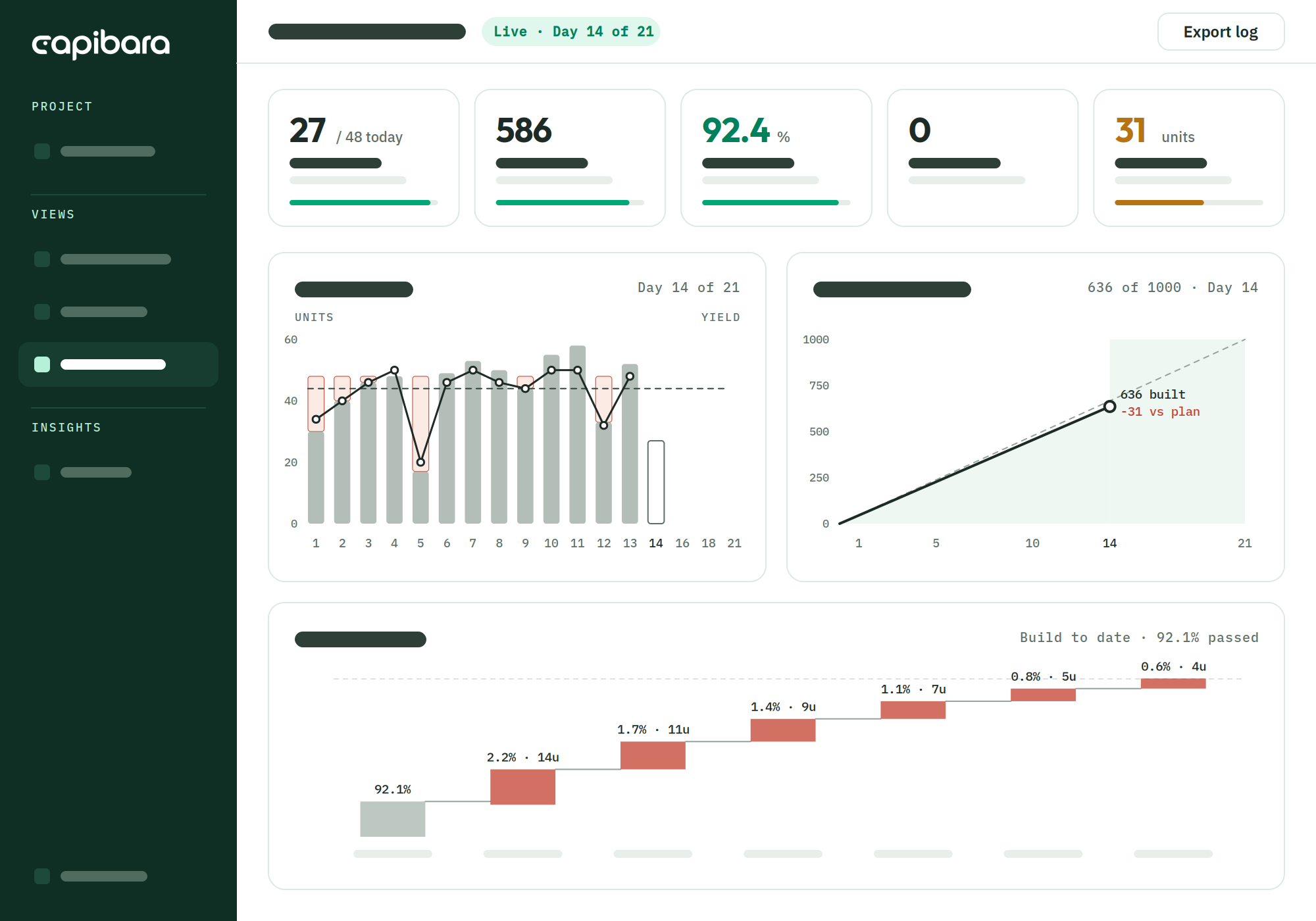
The line enters the daily. The CM enters its own. From that one entry Capibara builds the status, the trend, the gate and the recovery options, and engineering, quality, supply chain and leadership read the same picture the same morning. Nobody rebuilds a sheet. Nobody waits for Friday.

  • Two minutes a day, not a spreadsheet The numbers the floor already has. No retyping. No reconciling three versions.
  • The CM in the room It sees its line, its yield, its counts. Not your liability, your alternates or your cost.
  • A record that holds Every figure, the day it was reported, with who entered it. Ask how many were built with the wrong parts. The answer is already there.
app.capibaraai.com/portal
capibara-mockup-product-cm-portal

The weekly, in advance

The questions nobody can answer on the day they're asked.

  • Why are we finding out now?
  • Didn't we already qualify this?
  • How many did we build with the wrong parts?
  • Is that a bad day or a trend?
  • Whose number is right, ours or the CM's?
  • What does the new date cost?

Capibara answers all six before the meeting does. One bad day is noise. Three is a trend.

Slip signals

Three days is a trend. You hear about it on the third.

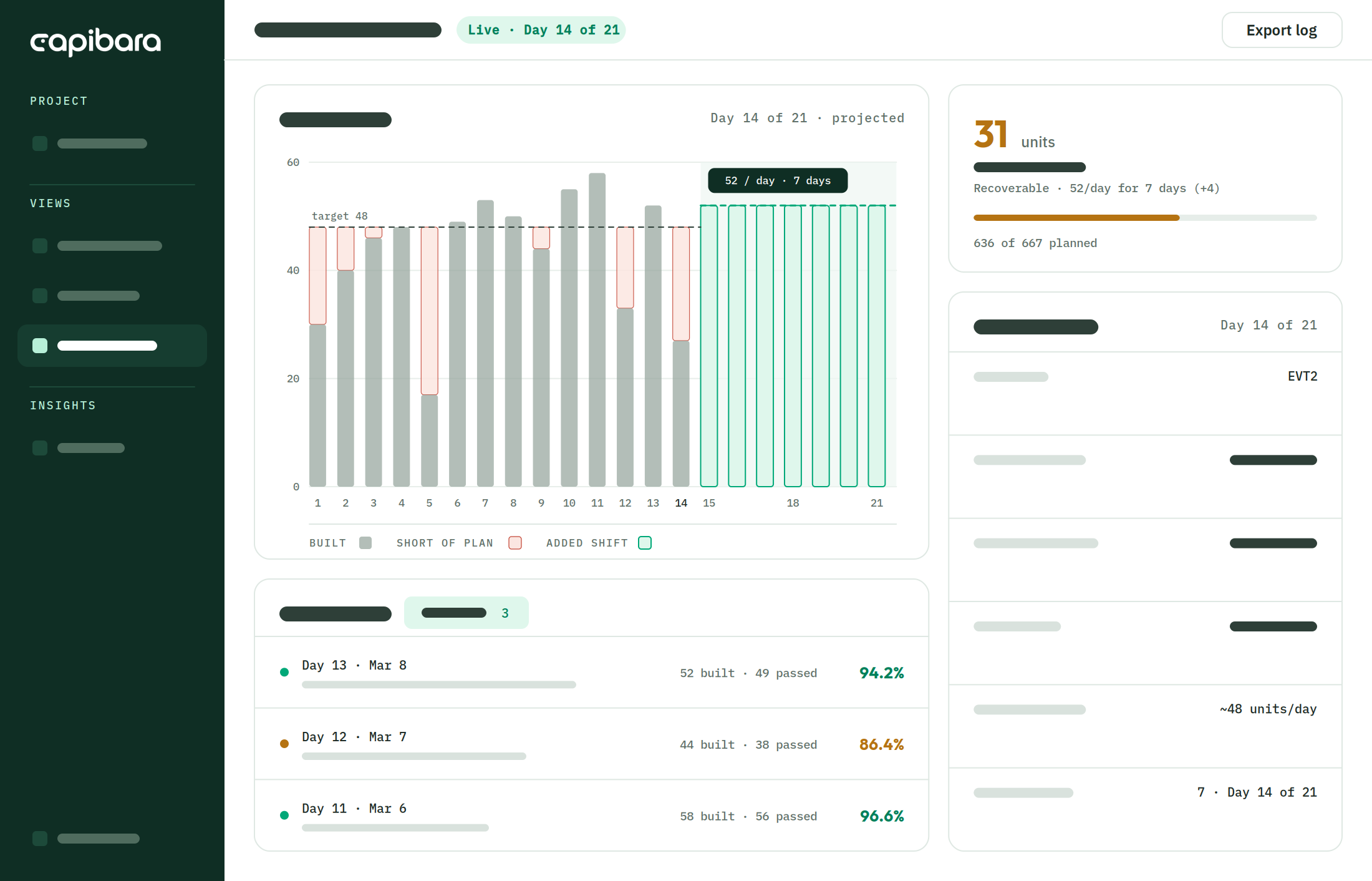
One bad day is noise. Three days running, with the gap not closing, is a slip. Capibara knows the difference.

One bad day

Noted, not flagged

  • 44 built against 48. Logged in the daily
  • Yield dipped to 86%. Watched, not escalated
  • Nobody is told. There is nothing to tell yet
With Capibara

Three days running

Flagged, the third morning

  • The gap is 3 days and not closing. In days, at today's rate, with the date it makes MP
  • The build owner, the function and the CM are told. Same morning, same picture
  • The ladder is attached. L1 to L3 still open, L3 expires first

The recovery ladder

There are five things you can do when a build slips.

Rebalance the line, add a shift, air freight, second source, or move the date. Each costs more than the one before it, and the first rungs expire first. The job is to pull the lowest rung that still closes the gap, while it is still there.
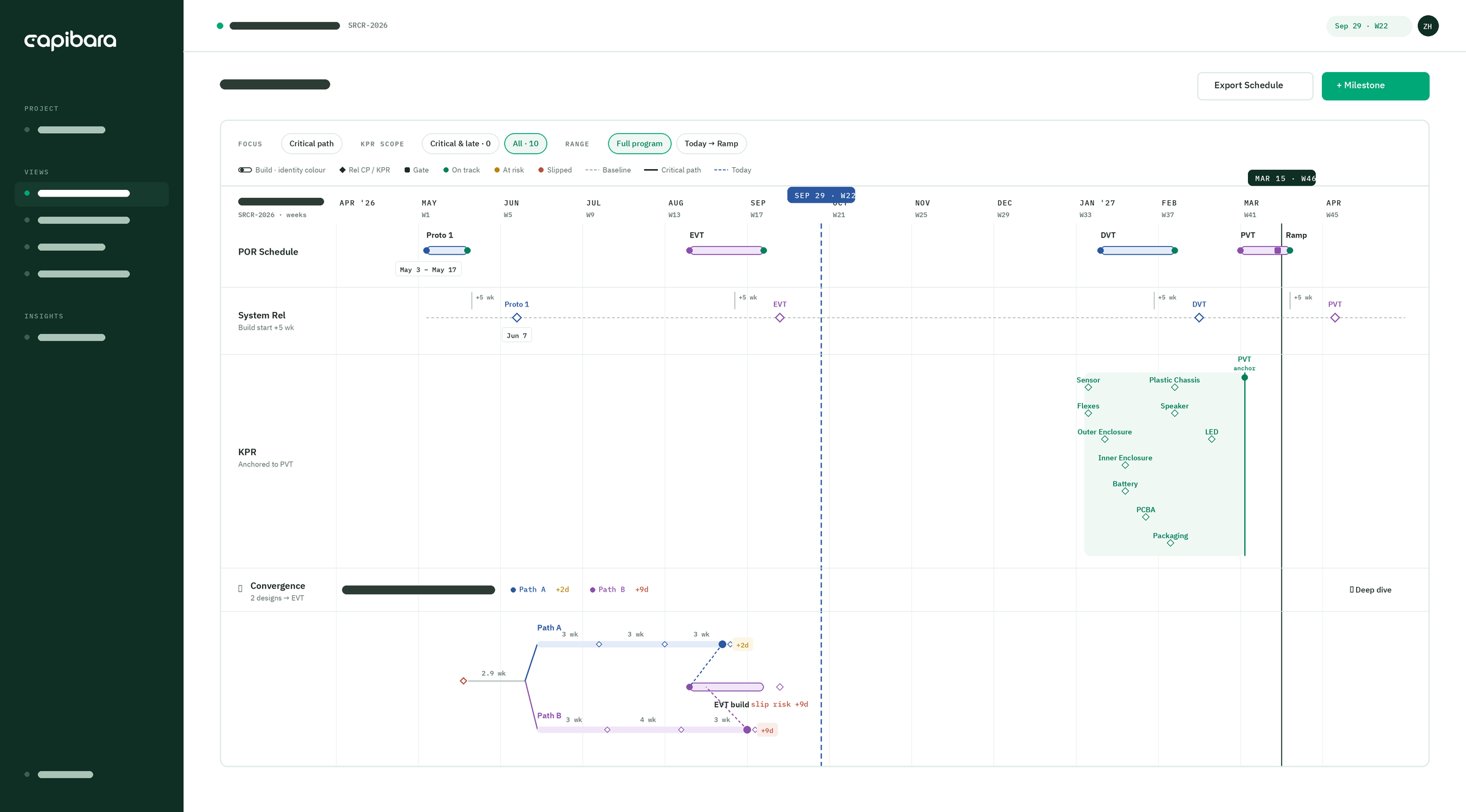
capibara-mockup-schedule

CORA

Recovery is a math problem.

A P2 part fails qualification mid-EVT. CORA reads the live build, the BOM, lead times and freight, and searches every combination of rungs against the date. Mixed-integer programming and Monte Carlo, run against your build, not a benchmark. It does not hand you one answer. It returns the frontier: the plans not beaten by another on cost, days and risk, side by side. You pick.

  • $ 420 k

    Air freight and expedite

    0 to 3 day slip. Low residual risk. Buys time with money.

    PLAN A · L3 · LOGISTICS

  • $ 165 k

    Re-sequence and swap

    About 7 day slip. Medium risk, from qualification.

    PLAN B · L1 + L4 · SOURCING

  • $ 40 k

    Accept the slip, hold for sea

    18 to 25 day slip. Low residual risk. Costs the date, not the budget.

    PLAN C · L5 · COMMITMENT

  • 25 days

    The width of the frontier

    Same failure. The plans differ by $380k and 25 days, and none of them is wrong.

    A TO C · ILLUSTRATIVE

The gate

Checked against the build.

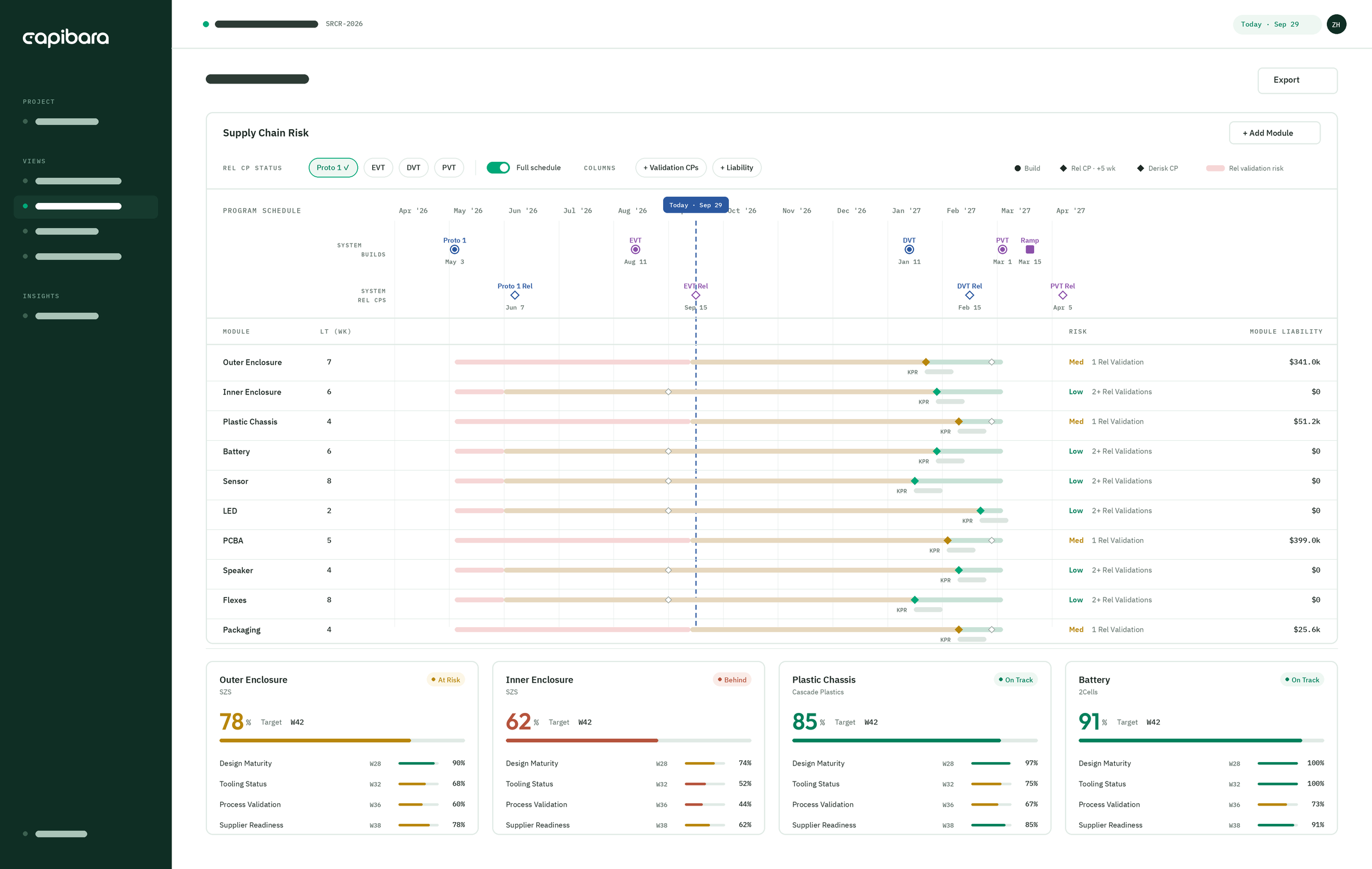
Every gate has a list. Capibara checks it against what the build has actually done, not against the deck: the yield, the CTB, the test, the date. What is met, what is open, what is still an assumption, and who owes the answer. OK2Ship is a state of the record, not a meeting.
app.capibaraai.com/readiness
capibara-mockup-readiness

Get started

Bring the build.

Forty-five minutes, your plan and the CM's latest daily. We walk the build from the last gate to the next. You leave with the picture.

Set up from the spreadsheet you already have.